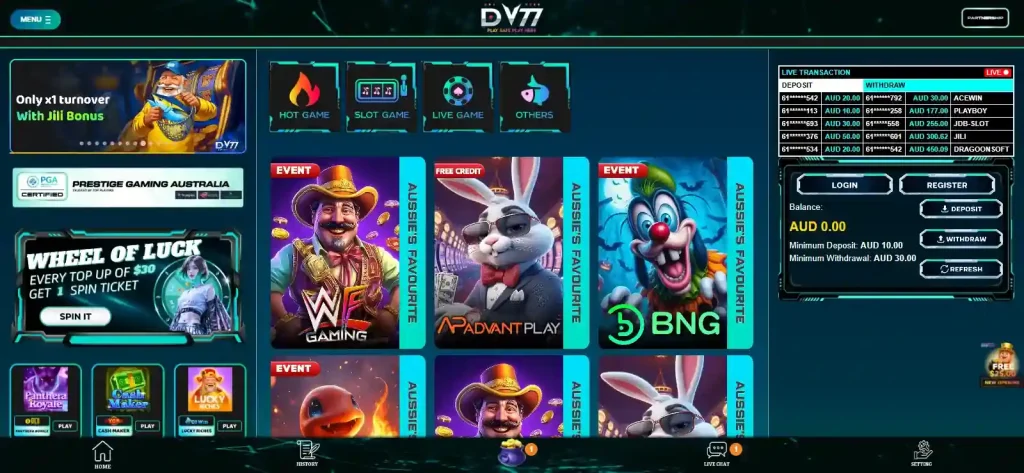
DV77 Registration and Account Verification Guide
 Available in AU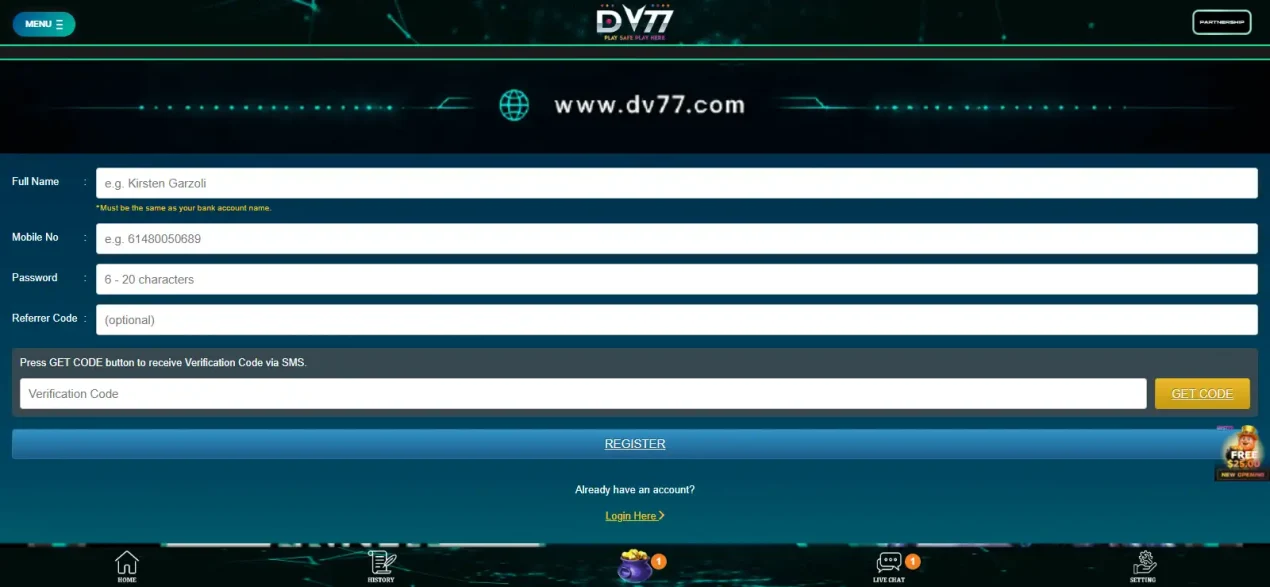
Contents
DV77 provides an account registration flow and its current official information says users should enter accurate, real personal details. Those details matter later because identity verification can be required before a withdrawal is approved. The current withdrawal guide also lists a minimum cashout of A$30. The available official information does not establish a fixed universal KYC document list or a guaranteed verification processing time.
The most useful way to think about DV77 registration is as one account lifecycle: sign up with accurate information, use payment methods that belong to you, keep account details consistent, and be prepared to verify identity or payment ownership if the account is checked. Verification is therefore not a separate topic detached from registration. It is one of the reasons the information entered at sign-up needs to be correct from the beginning.
What is verified about DV77 registration
The official DV77 FAQ tells users to follow the registration steps and enter their details carefully. It also says real and current details should be used because incorrect information can create problems when verification is needed. This supports a straightforward account rule: register as yourself and keep the profile information accurate.
That may sound obvious, but it has practical consequences. Casino accounts connect identity, login credentials, payment activity and withdrawals. If information is entered incorrectly at sign-up, later payment or verification checks can expose the mismatch. A typo is different from deliberately using false information, but either can create a need to correct the account before a payment request proceeds smoothly.
The available information does not justify describing every form field in advance because registration interfaces can change. The reliable principle is accuracy rather than a fabricated step-by-step list of fields. Use the current official form presented on the site, read the labels carefully and review the information before submitting it.
A practical DV77 sign-up sequence
A useful registration checklist can stay specific without pretending the interface is frozen in time:
- Open the official registration flow. Confirm that you are on the intended DV77 site before entering personal information.
- Enter current personal details. Use information that accurately identifies you rather than nicknames or invented data where the form asks for identity information.
- Create account credentials you can protect. Treat the login as a financial account credential because the account can contain payment and withdrawal information.
- Review the details before submission. Correct errors at the start rather than waiting until a verification or withdrawal check exposes them.
- Read the current terms that apply to the account. Registration creates an ongoing relationship with the site’s account and payment rules, not just a one-time login.
This sequence avoids assumptions about fields the current evidence does not freeze. It also keeps the focus on the reason registration quality matters: the information may later be checked against identity or payment ownership.
When DV77 verification can become relevant
Current DV77 material links identity verification to withdrawals. The official FAQ says verification is used to confirm that the account belongs to the correct person before certain payment actions are processed. The withdrawal guide tells users to make sure identity verification has been completed if required before submitting a request.
That means verification should not be treated as an unexpected topic that appears only after a problem. It is a normal account-control possibility around cashout. A user can prepare for that possibility by keeping registration details correct and by using payment methods they are entitled to use.
The current official information does not provide a fixed document checklist or a guaranteed turnaround time that applies to every user. A passport, driver’s licence, utility bill or specific number of hours should therefore not be treated as universally mandatory. If the account asks for verification, follow the live instructions provided through the official account or support process.
Why accurate account data matters before a withdrawal
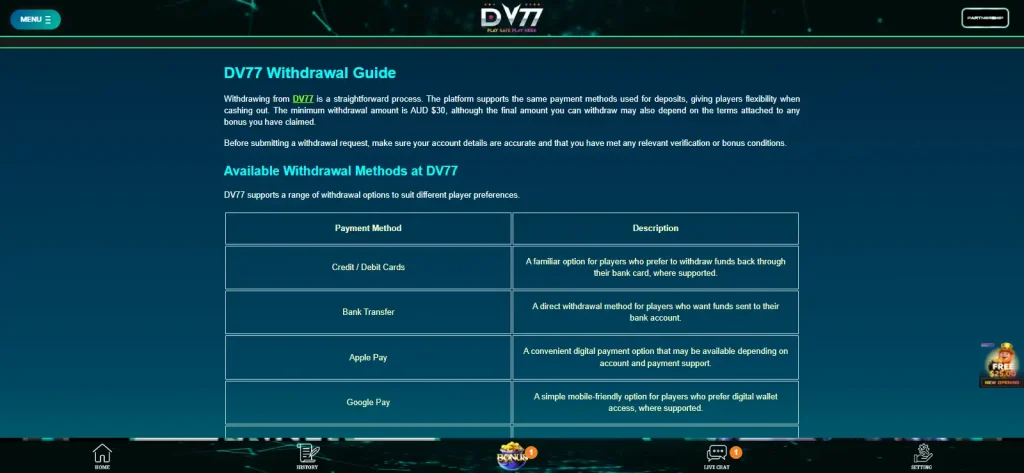
DV77’s current withdrawal guide says account details should be accurate and notes that incomplete verification can delay a withdrawal. It also lists A$30 as the current minimum withdrawal. The amount is a cashout threshold, while verification is an account-status check. They are separate conditions and should not be confused.
A withdrawal can therefore be affected by more than the amount entered. The guide also points users to bonus conditions and payment-method eligibility. For a full explanation of those cashout factors, use the dedicated DV77 withdrawals. This account page focuses on the identity and data side of the process.
From a user perspective, the best preparation is consistency. The name and other identifying data attached to the account should be accurate, and the payment route should not create an obvious ownership mismatch. If the platform asks for verification, resolving the request before repeatedly resubmitting a withdrawal is more sensible than assuming the request will disappear.
Payment ownership and account integrity
The registration, payment and withdrawal stages form one chain. DV77 supports Australian-dollar deposits and lists several payment options, but the presence of a method does not remove the need for the account and payment activity to be coherent. A payment instrument should be used in line with the site’s current rules and should not create uncertainty about who controls the account.
This is where many generic KYC guides become too specific. They often jump directly to a list of documents even when the operator’s current primary material does not support that list. The more defensible preparation advice is broader: keep account information accurate, retain access to the payment method you used, be ready to establish identity or payment ownership if the operator requests it, and respond through the official account or support channel.
Readers comparing deposit methods, AUD access and the current official banking options can use the DV77 payments. It separates the verified payment facts from account-verification assumptions.
Limits of the available DV77 KYC information
Four common KYC claims are not supported as universal facts by the current information.
- No fixed document list: the sources support identity verification as a process, not a universal checklist of named documents for every account.
- No guaranteed processing time: there is no verified promise here that KYC will be completed within a specific number of minutes, hours or days.
- No “no KYC” claim: the official material explicitly connects verification with withdrawals, so describing the service as no-KYC would conflict with the source evidence.
- No Australian-licence implication: creating an account or being accepted by a website is not proof that the operator holds an Australian local gambling licence.
The last distinction is especially important. Account availability, operational acceptance and local licensing are different questions. The DV77 licence and trust guide deals with the regulatory evidence separately rather than using registration as a proxy for licensing.
How to reduce avoidable account problems
Most useful preparation steps do not require knowing the exact KYC document set in advance. They are basic account hygiene that remains sensible throughout the lifecycle.
- Use accurate and current personal information when the form asks for it.
- Review spelling and dates before saving account details.
- Use a strong, unique password and protect access to the device or browser where credentials are stored.
- Do not share the account or allow another person to use your identity details.
- Keep access to the payment method used for deposits in case ownership needs to be established.
- Read any verification request carefully and respond only through the official account or support flow.
- Before requesting a withdrawal, check account status and any relevant bonus conditions rather than assuming the cashout amount is the only requirement.
These steps are deliberately non-specific about documents. They help prepare for verification without turning an unknown checklist into a false certainty.
Registration on mobile
DV77 supports mobile-browser access, so account functions can be used from a phone or tablet. Registration on a smaller screen adds one practical risk: autofill and mobile keyboards can make incorrect information easier to overlook. Review the completed form before submission, especially any field that affects identity or future account recovery.
A phone is also more likely to be used in public or shared environments. Avoid entering account credentials on a device you do not control, and do not leave an authenticated session open where another person can access it. The DV77 mobile guide explains the browser-based mobile setup and why that should not be confused with a verified native app.
If verification is requested
The correct response is to follow the request actually shown to the account. Read what the operator asks for, check that the request is being made through an official channel and provide only the information needed for that process. If the instructions are unclear, DV77 lists support channels that can be used to ask for clarification.
Because no universal processing time is established, avoid planning a withdrawal around an assumed same-day or fixed-hour verification promise. Verification status can be one factor affecting withdrawal timing, but the current official material does not provide a numeric KYC turnaround guarantee.
If a withdrawal is already pending, consult the withdrawal page for the verified cashout conditions and use support for account-specific status. Do not repeatedly create new accounts to work around a verification issue, because that can create additional identity and account-integrity problems rather than solving the original one.
Registration does not answer the licensing question
A website can present a registration flow to an Australian user without that fact proving local licensing. Operational account access should therefore be kept separate from the regulatory question. The account page explains what the DV77 sources say about sign-up and verification. The trust section examines licensing and Australian regulatory evidence on its own terms.
That separation is useful because it prevents a common logical shortcut: “I can register, therefore the operator must be locally licensed.” Those are not the same proposition. Readers who want to evaluate the regulatory side should move to the licence and trust facts rather than infer it from the sign-up form.
What matters before creating a DV77 account
DV77 registration should be approached as the beginning of an account lifecycle, not as an isolated form. The verified rules are simple: enter accurate personal details, expect that identity verification can be required around withdrawals, and keep payment and account information consistent. The current official withdrawal guide lists a A$30 minimum cashout and indicates that verification status can affect withdrawal processing.
The available information does not support a fixed universal KYC document list or guaranteed processing time. If verification is requested, rely on the live instructions presented through the official account or support process. That is more precise than copying a generic casino KYC checklist that may not match DV77’s current requirements.
FAQ
Do I need real details to register with DV77?
Current official DV77 information says users should enter real and current details. Incorrect information can create problems later, especially when verification or a withdrawal is involved.
Does DV77 require identity verification?
DV77’s current FAQ and withdrawal guide say identity verification can be required before certain payment actions or withdrawals are approved.
Which KYC documents does DV77 require?
Current official information does not establish a fixed universal document list. Follow the instructions presented to your account if verification is requested.
How long does DV77 verification take?
No guaranteed verification time is established by the current official information. Account-specific instructions or support should be used for current status.
What is the current minimum DV77 withdrawal?
The official withdrawal guide currently lists a minimum withdrawal of A$30. Other account, payment and bonus conditions can still affect whether a withdrawal is ready for approval.
This material was created by the DV77 Australia Guide team.
Related posts
DV77 and Australian Online Casino Regulation Explained
DV77 Withdrawals: Minimum Cashout, Methods and Verification